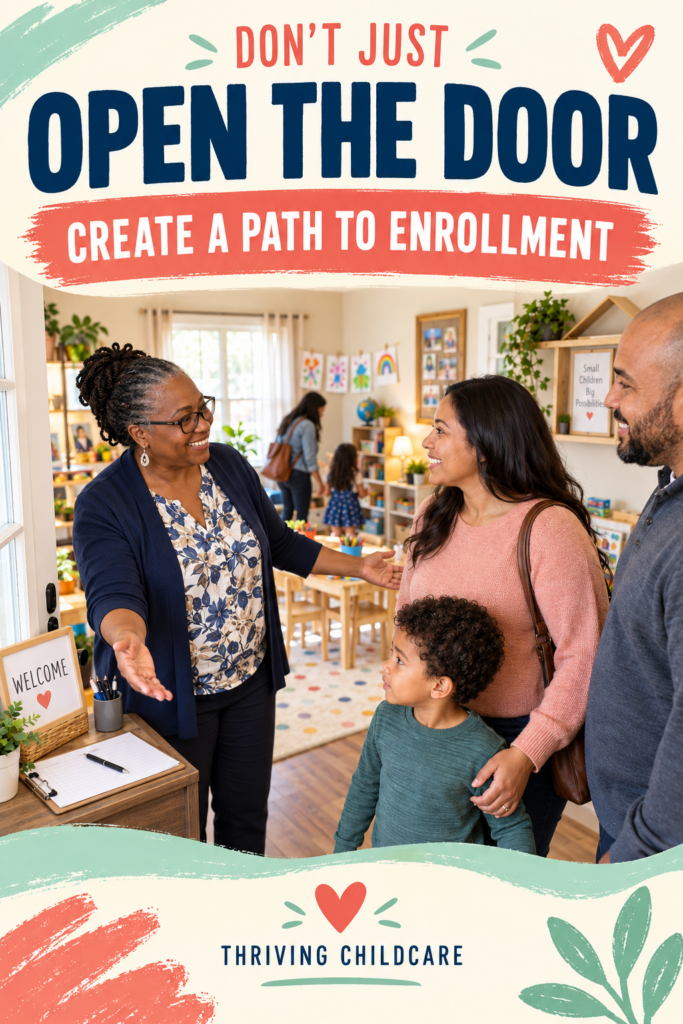
If you’ve been repeatedly posting “Now Enrolling!” but still aren’t hearing from enough serious families, it may be time to learn how to host a childcare open house that does more than simply get people through the door. A well-planned open house can help prospective parents experience your program, understand what makes your care valuable, and picture their child in your environment. In this post, we’ll look at how to attract better-fit families, guide them through a purposeful open-house experience, ask the right questions, and give interested parents a clear path from “This looks nice” to “How do we enroll?”
7 Easy Steps for How to Host a Childcare Open House
You’ve posted “Now Enrolling!”
Then you posted it again.
You changed the background color, added a few cute emojis, listed your available openings, and shared it in every local parenting group that would let you in.
And still…crickets. 🦗
GET A PRINTABLE AD-FREE VERSION OF THIS BLOG POST HERE FOR ONLY $3.99!
Want a super handy, printer-friendly version of this blog post—without all the ads? Grab it for just $3.99!
When you download this printable guide, you’ll get all the information from this post, plus the convenience of having everything in one place. No more scrolling through pages or trying to remember where you saw that key detail! *Of course, grabbing the printable is totally optional—you can still follow along right here on the blog. But if you love a good shortcut (and who doesn’t?), this one’s for you! Just CLICK HERE!
Or maybe you received a few messages from parents who asked, “How much?” and then disappeared into the same mysterious place where unmatched socks and missing sippy-cup lids go.
If this sounds familiar, you’re not alone.
Posting that you have openings can let families know that space is available. But an announcement by itself doesn’t always give a parent enough information—or enough of a connection—to take the next step.
Sometimes families need an opportunity to meet you, see your childcare environment, ask questions, and understand what makes your program different.
That is where a childcare open house can help.
But let’s be clear:
The goal is not simply to get people through the door.
The goal is to help the right families move closer to enrollment.
Here’s how to host a childcare open house that doesn’t just look nice, but actually creates meaningful enrollment opportunities for your program.
“Now Enrolling” Is an Announcement—Not an Entire Enrollment Strategy
There is nothing wrong with posting that you have openings.
You should let people know when space is available.
But most prospective parents need more than an announcement before they are ready to place their child in someone’s care.
Think about the decision they are making.
They aren’t choosing a new coffee shop.
They’re choosing the person and environment that may care for their child for eight, nine, or even ten hours each day.
That decision involves trust.
Para 1Parents may want to know:
- Who will be caring for my child?
- What does the childcare environment feel like?
- How will my child spend the day?
- Will my child be safe and comfortable here?
- How does the provider communicate with parents?
- Does this program’s schedule work for my family?
- Does this provider seem organized and professional?
- Can I picture my child being happy here?
A social-media graphic can introduce your program.
An open house can help families experience it.
That doesn’t mean every person who attends will enroll. Some families won’t be the right fit, and that is okay.
A successful open house is not about collecting as many random people as possible.
It is about creating an intentional opportunity to connect with families who may genuinely need what your program offers.
1. Begin With a Specific Enrollment Goal
Before choosing refreshments or worrying about decorations, decide what you want your open house to accomplish.
Ask yourself:
- How many openings do I currently have?
- Which age groups am I enrolling?
- When are those spaces available?
- Which schedules can I accept?
- Am I trying to fill current openings or build a future waiting list?
- What kind of family is most likely to succeed in my program?
- What do I want interested parents to do after attending?
Maybe you have one infant opening available next month.
Maybe two preschool children recently left for Transitional Kindergarten, and you need to reach families with younger children.
Maybe you are fully enrolled but want to build a waiting list before your next opening becomes available.
Those are three different goals.
Your goal will shape how you market the event, which families you invite, what information you emphasize, and what next step you offer.
If you don’t know what you want attendees to do, they probably won’t know either.
A successful open house starts with a clear destination.
Let’s make your childcare program even more amazing together! CLICK HERE to see how Adrienne can help you tackle the toughest challenges in your childcare business, boost your growth, and set you on the path to success.
2. Give the Right Families a Reason to Attend
“Come to my childcare open house” may not be enough to make a busy parent rearrange her evening or give up part of her Saturday.
Your invitation should explain what the parent will gain by attending.
For example:
Tour our home childcare program, meet your provider, learn about our daily routine, and discover our current infant and toddler openings.
That is much more useful than:
Open house Saturday! Come by!
When promoting your event, clearly communicate:
- The ages you serve
- The openings you expect to have
- The date and time of the event
- Whether families must register
- What parents will see or learn
- What makes your program distinctive
- Whether children are welcome to attend
- What the next step will be for interested families
Use your website, email list, social-media pages, local parent groups, childcare directories, flyers, and current or former families to spread the word.
But don’t market only to “parents.”
Market to the parents whose needs match your program.
If you offer early hours, say that.
If you specialize in infant and toddler care, say that.
If you keep siblings together, serve meals, offer a small group environment, or have twenty years of experience, say that.
This is not the time to become shy about the value of your childcare program.
The right family cannot recognize a good fit if you never explain what makes your program different.
3. Create a Guided Experience—Not a Childcare Free-for-All
An open house should feel warm and relaxed, but it still needs structure.
You don’t want families wandering through your childcare space while you stand in the kitchen wondering whether anyone signed in.
And you definitely don’t want to finish the event with six empty cups, crumbs in the dramatic-play area, and no way to contact the people who attended. 😩
Think about the experience from the moment a family arrives until the moment they leave.
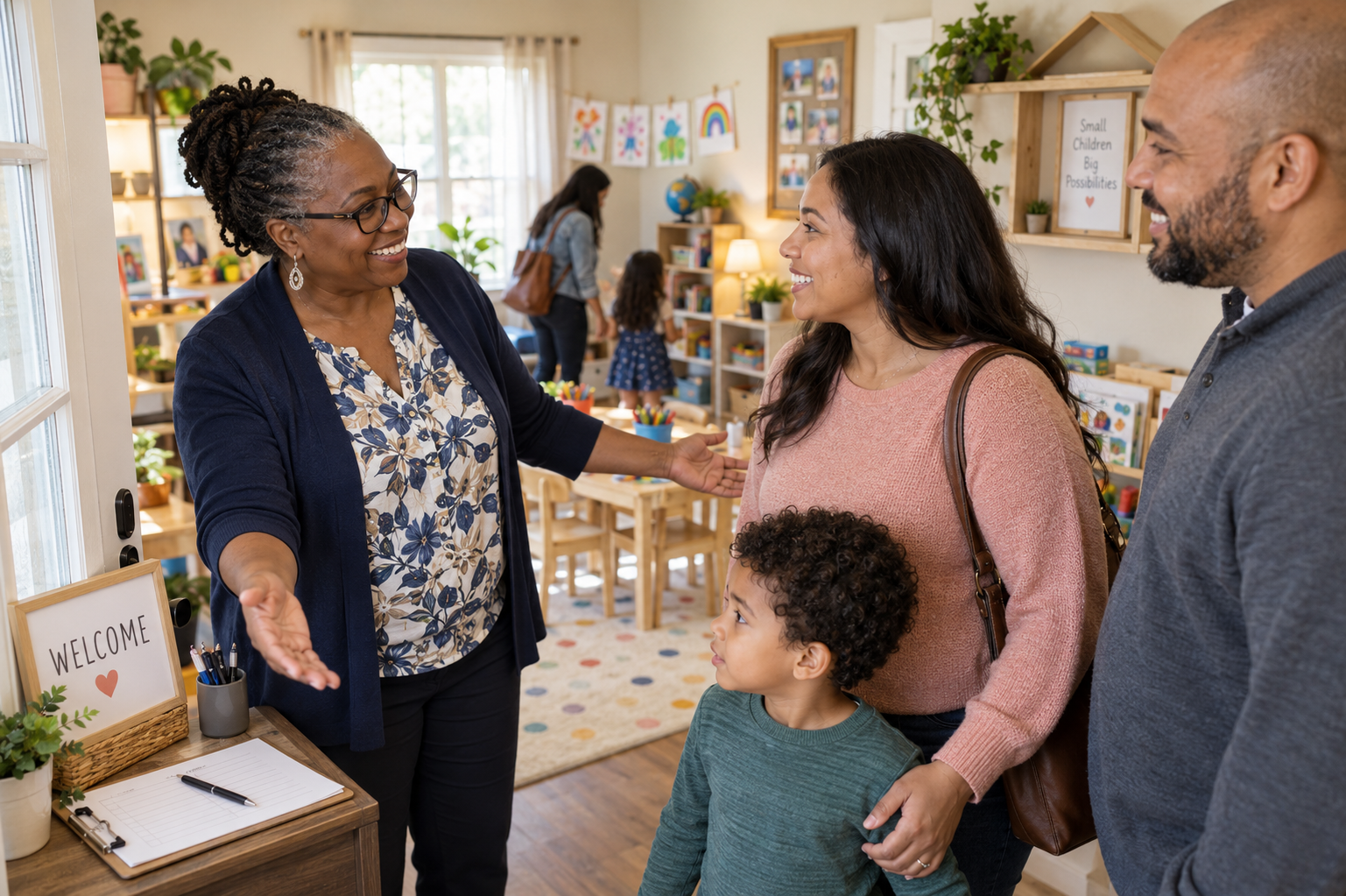
A simple flow might look like this:
- Welcome the family.
- Ask the parent to sign in.
- Offer a brief introduction.
- Guide the family through the approved childcare areas.
- Explain your daily routine and program highlights.
- Give the child an opportunity to explore a prepared activity.
- Invite the parent to ask questions.
- Ask a few questions about the family’s childcare needs.
- Explain the next step.
- Provide an application, tour appointment, or follow-up information.
If several families attend at once, you might schedule a short group welcome followed by smaller walkthroughs.
If you are hosting a very small event, you might assign arrival windows so you can give each family more personal attention.
There is no single perfect format.
What matters is that families are not left to figure everything out for themselves.
You are guiding them through the experience and toward an appropriate next step.
Of course, protect the privacy and safety of your current childcare families. Secure children’s records, medications, keys, personal information, and any areas guests should not enter. Schedule the event when you can appropriately supervise visitors and follow your licensing, insurance, and program-safety requirements.
Professional does not have to mean stiff.
But it should mean prepared.
4. Help Parents Picture Their Child in Your Program
It is one thing to tell parents that your program offers engaging activities.
It is another thing for them to see an inviting activity area and imagine their own child sitting there.
It is one thing to say that you provide nutritious meals.
It is another thing to show a sample menu or offer a small taste of something you regularly serve.
It is one thing to say that your childcare day is organized.
It is another thing to show your daily schedule, parent-communication system, curriculum examples, and clearly prepared environment.
During your open house, look for opportunities to show—not just tell—families what their child’s experience could be like.
You could display:
- A sample daily schedule
- Weekly menus
- Photographs of activities, with proper permission
- Examples of children’s artwork
- Curriculum or lesson-plan samples
- Your parent handbook
- A childcare portfolio
- Parent testimonials
- Your training and credentials
- A list of program benefits
- Information about how you communicate with families
- A sample welcome or enrollment packet
You can also set up one or two simple activities for visiting children.
This keeps the children engaged while their parents speak with you, but it does something else too.
It allows parents to see how their child responds to the environment.
For a moment, they can begin to picture what it might feel like to bring their child there each day.
That emotional connection can be much more powerful than another list of features.
5. Ask Questions Instead of Doing All the Talking
It is tempting to spend the entire open house telling families everything about your childcare program.
After all, you have a lot to share.
But enrollment is not only about whether the parent likes your program.
You also need to determine whether the family is a good fit for your business.
Ask questions such as:
- What type of childcare arrangement are you currently using?
- Why are you looking for a new program?
- When do you need care to begin?
- What days and hours do you need?
- How old is your child?
- What is most important to you in a childcare program?
- Has your child been in group care before?
- Are there any scheduling, developmental, medical, dietary, or family needs we should discuss?
- What questions or concerns do you still have?
- Are you considering other childcare programs?
Listen carefully to the answers.
A parent may reveal that she needs hours you do not offer.
A family may be looking for a teaching approach that does not match your program.
Or the parent may describe exactly the type of environment you provide.
You are not interrogating anyone under a bright lamp. 😂
You are having a professional conversation that helps both sides decide whether moving forward makes sense.
6. Make the Next Step Extremely Clear
Do not assume interested parents will automatically know what to do after your open house.
Tell them.
Should they complete an application?
Schedule an individual tour?
Join your waiting list?
Submit an enrollment fee?
Review your parent handbook?
Expect an email from you the next morning?
Whatever your process is, explain it clearly before they leave.
You might say:
“If you would like to be considered for the opening, complete this application before you leave. I’ll review applications on Monday and contact families about the next step.”
Or:
“We do not have an immediate opening, but you can join the waiting list tonight. I’ll keep your information and contact you when an appropriate space becomes available.”
Or:
“The next step is a private family interview. You can choose an appointment time using this form.”
This is also why you should be prepared with the right materials.
Depending on your process, you may need:
- Enrollment applications
- Waiting-list forms
- Tour appointments
- Program brochures
- Business cards
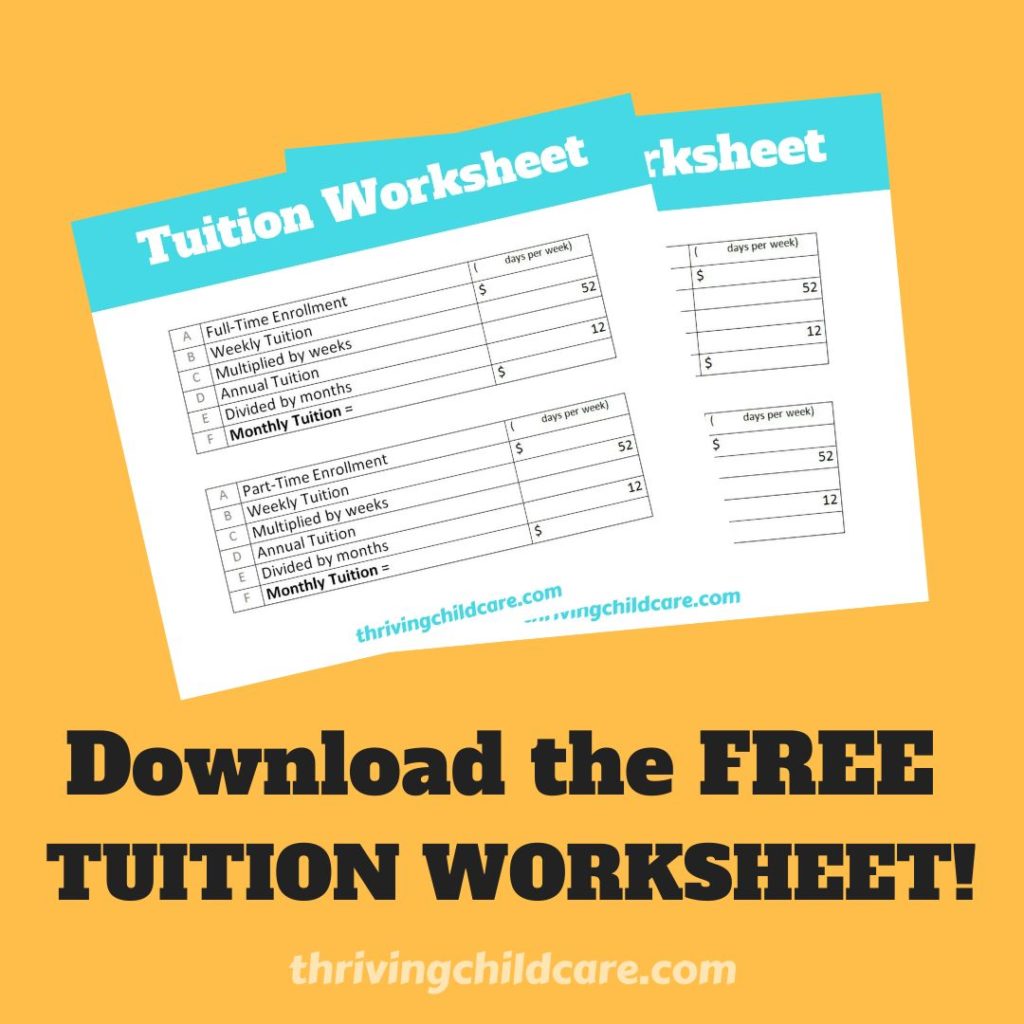
- Tuition information
- Parent handbooks
- Daily schedules
- FAQ sheets
- Enrollment-fee information
- A checklist explaining the next steps
A parent who is ready to move forward should not have to hunt you down three days later to ask how.
Interest needs direction.
Related Reading:
7. Follow Up While the Experience Is Still Fresh
Your open house is not over when the last family walks out the door.
Before you put away the refreshments and collapse on the couch, make sure you know:
- Who attended
- Which families appeared to be a good fit
- Who requested an application
- Who needs an individual tour
- Who asked to join the waiting list
- What questions still need answers
- When you promised to follow up
Send a thank-you message within 24 to 48 hours.
Keep it personal whenever possible.
Mention something specific you discussed, answer any remaining questions, and repeat the next step.
For example:
“It was wonderful meeting you and Maya yesterday. I enjoyed hearing about how much she loves music and sensory activities. Based on the schedule you need, I believe our upcoming toddler opening may be a good fit. Here is the application we discussed. Please return it by Friday if you would like to be considered.”
That message is much stronger than:
“Thanks for coming. Let me know if you need care.”
Follow up with the families who seemed interested but weren’t ready to decide.
People get busy.
They misplace paperwork.
They intend to respond and forget.
A thoughtful follow-up is not bothering them. It is helping them complete a decision they already started considering.
Of course, you do not need to chase someone for six months like you are trying to collect on an old cable bill. 😂
Follow up professionally, explain any deadlines, and then allow the parent to decide.
Your Open House Does Not Need to Be Huge
When some home childcare providers hear “open house,” they immediately picture a large childcare center with a parking lot, ten employees, balloons, catered food, and a person wearing a headset directing traffic.
That is not required.
Your open house could be:
- A small Saturday morning gathering
- A “Come Meet Your Provider” event
- An evening enrollment preview
- A scheduled drop-in tour window
- A neighborhood family information day
- A seasonal open house
- A virtual information session followed by private tours
- Two or three scheduled small-group sessions
You can design the event around your space, schedule, capacity, and business needs.
A smaller event may even allow you to have more meaningful conversations with prospective families.
The goal is not to impress the entire community in one afternoon.
The goal is to create a comfortable, professional opportunity for the right families to discover your program.
Don’t Try to Keep Every Open-House Detail in Your Head
Planning an open house involves more little details than most providers expect.
You need to choose a date, promote the event, prepare the childcare environment, plan refreshments, organize children’s activities, decide what to say, collect contact information, guide families through the program, prepare enrollment materials, and remember to follow up.
And you are doing all of that while continuing to run your childcare business.
Because apparently your regular to-do list was not long enough. 😩
That is why I created the My Childcare Open House Binder Kit.
The kit includes more than 50 printable pages to help you plan and organize your event, including:
- A 12-month planner
- Cleanup and preparation checklists
- Refreshment planning
- Talking-points pages
- Children’s activity planning
- To-do lists
- Task-assignment worksheets
- A music-playlist planner
- Guest sign-in pages
- An enrollment application
- Waiting-list pages
- Event-notes templates
- A tour guide checklist
- Parent feedback forms
- A customizable welcome sign
- A bonus guide to creating a childcare FAQ
Instead of opening another blank document and trying to remember every detail yourself, you can print the pages you need and create an organized plan for your event.
👉 GET THE MY CHILDCARE OPEN HOUSE BINDER KIT →

If you need help with the basic event-planning steps, you can also read my earlier guide, How to Actually Host an Amazing Daycare Open House.
Don’t Just Open the Door—Create a Path Toward Enrollment
A childcare open house can help your program stand out from another “Now Enrolling” post.
But getting families through the door is only the beginning.
You need to attract families whose needs match your program.
You need to create a welcoming and organized experience.
You need to show parents what makes your care valuable.
You need to ask questions and listen to the answers.
You need to explain the next step.
And you need to follow up.
You cannot guarantee that every person who attends will enroll.
But you can make sure that serious families leave your event understanding what your program offers, whether it may be a good fit, and exactly what they should do next.
Your childcare program is worth seeing.
Now open the door—and give the right families a clear path to say yes. ❤️