
Setting daycare parent boundaries sounds simple enough when everything is written neatly in your handbook—but actually enforcing those boundaries can be a whole different story. What do you say when tuition is late, a parent arrives after closing, asks you to bend a policy, or puts you on the spot with a request you weren’t expecting? In this post, we’re going to talk about why these conversations can feel so uncomfortable and, more importantly, how to make them easier. You’ll learn how to stop over-explaining, give yourself permission to pause before answering, and prepare simple, professional language ahead of time so you can communicate your policies with warmth, clarity, and confidence.
You know what you need to say.
You’ve probably rehearsed it in your head three times.
But then the parent walks through the door.
Suddenly, “Tuition needs to be paid on time” turns into, “No worries, just get it to me when you can.”
Or “Pickup is at 5:30” becomes, “It’s okay this time.”
Or the policy you carefully wrote in your handbook somehow becomes something you’re negotiating at your front door.
If you’ve ever walked away from a conversation with a daycare parent thinking, Why didn’t I just say what I meant? — you’re not alone.
Setting boundaries is one of those parts of running a childcare business that sounds simple on paper. In real life, it can feel incredibly uncomfortable—especially when you genuinely care about the families you serve.
But having boundaries doesn’t make you unfriendly, inflexible, or difficult to work with.
It makes it possible for you to run your childcare program without constantly making exceptions that leave you frustrated, exhausted, or resentful.
5 Reasons Why Providers Struggle to Find the Words
1. The Hardest Part Usually Isn’t Knowing Your Policy—It’s Saying It
Most childcare providers already know what their policies are.
You know when tuition is due. You know what time your program closes. You know when a child is too sick to attend. You know how much notice you require for schedule changes. You may even have all of it written clearly in your parent handbook and signed agreement.
The tricky part usually comes when you have to say it out loud to a parent.
It’s one thing to type, “Payment is due by Friday at 5:00 p.m.” into your handbook.
It’s another thing entirely to look at a parent you like and say, “Your payment is late, and the late fee now applies.”
The same thing happens with pickup times.
You may have a firm closing time, but when a parent texts that they are “just a few minutes away,” it can be tempting to brush it off—especially if you know they had a long day.
Or maybe a parent arrives with a child who clearly isn’t feeling well and says, “I think she’s okay. Can we just see how she does?”
Suddenly, that illness policy you felt perfectly confident about yesterday feels a lot harder to enforce.
That doesn’t mean your policy is wrong.
It usually means the conversation is uncomfortable.
And that’s where many providers get stuck.
GET A PRINTABLE AD-FREE VERSION OF THIS BLOG POST HERE FOR ONLY $3!
Want a super handy, printer-friendly version of this blog post—without all the ads? Grab it for just $3!
When you download this printable guide, you’ll get all the information from this post, plus the convenience of having everything in one place. No more scrolling through pages or trying to remember where you saw that key detail! *Of course, grabbing the printable is totally optional—you can still follow along right here on the blog. But if you love a good shortcut (and who doesn’t?), this one’s for you! Just CLICK HERE!
You don’t want to sound rude. You don’t want the parent to think you don’t care. You don’t want to create tension at drop-off or pickup. And, if enrollment has been slow, you may even worry that holding a boundary could cause a family to leave.
So you soften the message.
You make an exception.
You add, “Just this once.”
And sometimes that really is all it is—one exception.
But when exceptions start becoming the normal way you handle uncomfortable situations, your policies slowly stop functioning like policies and start feeling more like suggestions.
That can lead to late payments, repeated late pickups, parents pushing back on illness exclusions, schedule changes you never agreed to, and a whole lot of frustration on your end.
The goal isn’t to become harsh or inflexible.
It’s to get comfortable saying, calmly and professionally:
“This is the policy, and this is what needs to happen next.”
Because having a policy on paper is only half the job.
Being able to communicate it when the moment comes is what actually gives that policy its backbone.
Related Reading:
2. Stop Over-Explaining Your Boundaries
Have you ever started what should have been a two-sentence conversation with a parent and somehow turned it into a five-minute explanation?
It happens easily.
When we’re uncomfortable setting a boundary, we often try to make it sound softer by adding more words. We explain why the policy exists. We acknowledge everything the parent might be dealing with. We apologize for bringing it up. Then we explain ourselves one more time just to make sure they know we’re not trying to be mean.
Before long, the actual boundary is buried underneath all that explaining.
For example:
Instead of:
“I’m so sorry, and I completely understand that things happen, and I hate to even bring this up, but I really need everyone to try to arrive by 5:30. I have things I need to do after work too, and when someone is late it puts me behind…”
Try:
“Just a reminder that childcare ends at 5:30. Please make arrangements to have your child picked up by closing time going forward.”
That’s it.
Warm. Professional. Clear.
And, most importantly, there’s no argument hiding inside it.
When you give five reasons for a boundary, you may unintentionally give the other person five things to negotiate.
“I understand you have plans after work, but traffic was terrible.”
“I know tuition was due Friday, but my paycheck doesn’t come until Monday.”
“I know your sick policy says 24 hours fever-free, but she seems completely fine now.”
Suddenly, instead of communicating a policy, you’re debating whether your reason for enforcing it is good enough.
But your closing time doesn’t exist only because you happen to have plans that evening. Your tuition policy doesn’t apply only when you need the money that day. And your illness policy doesn’t change based on whether you can be persuaded that this particular child should be the exception.
The policy is the reason.
That doesn’t mean you can’t show empathy. You absolutely can.
You can say:
“I know unexpected things happen. Our late pickup policy still applies.”
Or:
“I understand this puts you in a difficult spot. Unfortunately, I can’t accept her into care today based on our illness policy.”
Notice what those statements do.
They acknowledge the parent’s situation without taking responsibility for fixing it.
That’s an important difference.
You can be kind without backing away from the boundary. You can understand without making an exception. And you can be professional without providing a long defense of a policy the family already agreed to.
Sometimes the most confident thing you can do is simply say what needs to be said—and stop talking.

3. You Don’t Have to Answer Everything in the Moment (This one always got me caught)
Sometimes the boundary problem starts before you’ve even had time to think.
A parent catches you at drop-off and asks if you can keep their child an extra hour on Friday.
Someone asks at pickup if they can switch their regular days next week.
A parent sends a text asking if they can pay tuition a few days late “just this once.”
And because they’re standing right in front of you—or because you feel like you need to respond to that text immediately—you say:
“Sure, I think that should be okay.”
Then five minutes later, you realize it actually isn’t okay.
Maybe the request conflicts with your policy. Maybe it creates a staffing or ratio issue. Maybe you’ve already made plans. Or maybe you simply realize that saying yes this time could create an expectation you don’t want to continue.
This is why one of the most useful sentences a childcare provider can keep in her back pocket is:
“Let me take a look at that and get back to you.”
That’s it.
You don’t have to decide right then.
You don’t have to fill an awkward silence.
And you definitely don’t have to say yes simply because you haven’t figured out how to say no yet.
Giving yourself a little space allows you to check your handbook, look at your schedule, think about how the request could affect your program, and decide what you actually want to do before you respond.
You can also use variations like:
“Let me check my schedule and I’ll let you know.”
“I want to look at our policy before I answer that.”
“Let me think about how that would work and I’ll get back to you this afternoon.”
These aren’t evasive answers. They’re professional ones.
And here’s another important piece: taking time to think does not obligate you to say yes later.
After looking at the request, your response may simply be:
“I took a look, and unfortunately I’m not able to accommodate that.”
No lengthy explanation required.
That little pause between the request and your response can prevent a lot of accidental exceptions—and a lot of resentment afterward.
Because sometimes having a little backbone doesn’t mean immediately saying no.
Sometimes it means giving yourself enough time to decide whether you really want to say yes.
4. A Script Isn’t Fake—It Gives You Something to Lean On
Some providers hear the word script and immediately think:
But I don’t want to sound scripted.
I get it. You want conversations with your daycare families to feel natural and genuine—not like you’re reading from a customer-service manual.
But having a script doesn’t mean you have to memorize every word and recite it exactly as written.
A script simply gives you a starting point.
Let’s make your childcare program even more amazing together! CLICK HERE to see how Adrienne can help you tackle the toughest challenges in your childcare business, boost your growth, and set you on the path to success.
Think about other professionals. Doctors prepare for difficult conversations with patients. Teachers think through how they’ll discuss concerns with parents. Managers prepare talking points before addressing an employee issue. Customer-service teams are given language for handling uncomfortable situations.
Preparation doesn’t make those conversations less genuine.
It makes them easier to navigate.
Childcare providers deserve that same advantage.
Because when a parent is standing in front of you asking for an exception—or sending you a text that immediately makes your stomach tighten—that is probably not the best time to figure out exactly what you want to say.
That’s when we tend to over-explain.
Or apologize.
Or say yes when we really mean no.
Or type a three-paragraph response, delete it, rewrite it, stare at it for another ten minutes…and still wonder whether it sounds too harsh.
Having prepared language gives you something solid to lean on.
Instead of starting with a blank screen, you might already have:
“I understand why you’re asking. Unfortunately, I’m not able to make an exception to this policy.”
From there, you can make it sound like you.
Maybe you make it warmer. Maybe you shorten it. Maybe you add the parent’s name or a quick acknowledgment of their particular situation.
The script isn’t there to replace your voice. It helps you find your voice when the conversation gets uncomfortable.
And the more often you practice communicating your boundaries clearly, the less you’ll need to rely on the exact wording.
Eventually, phrases that once felt difficult start coming naturally.
You stop searching for the perfect way to say something.
You stop worrying quite so much about whether a parent will be upset.
And you start trusting yourself to handle uncomfortable conversations professionally.
That’s the real value of having scripts ready.
They aren’t there to speak for you. They’re there to help you speak up.

5. Decide What You’ll Say Before You Need to Say It
The best time to figure out what you’re going to say during an uncomfortable parent conversation is before you’re having the uncomfortable parent conversation.
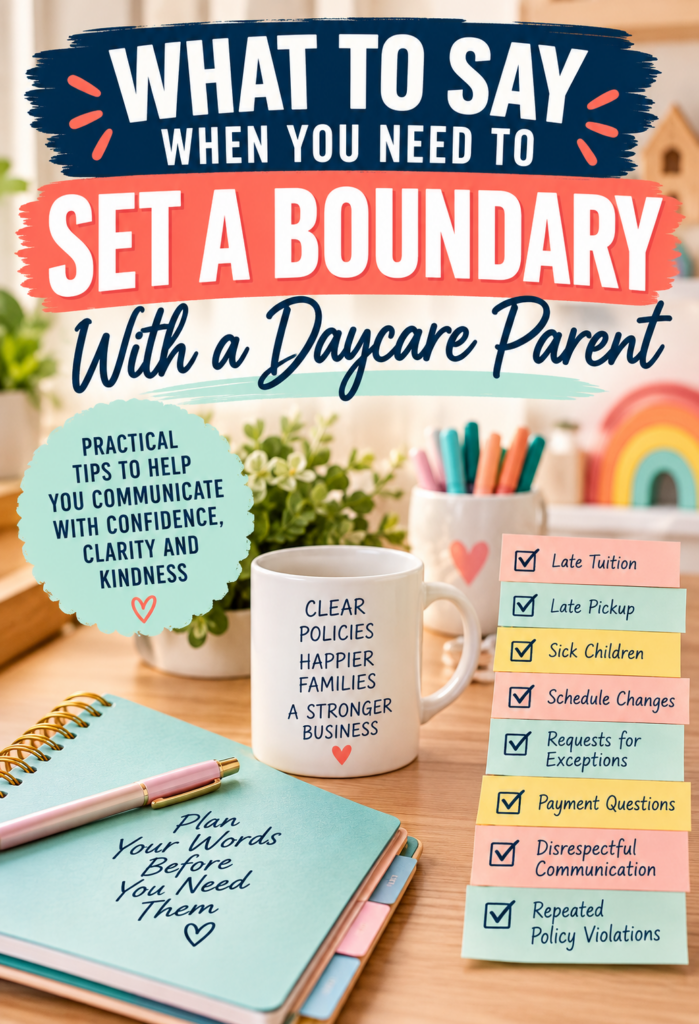
Think about the situations that tend to come up again and again in childcare.
A tuition payment is late.
A parent arrives after closing.
A child shows up with symptoms that fall under your illness policy.
A family asks you to make “just one little exception.”
Someone wants to change their contracted schedule.
A parent questions why they still have to pay when their child is on vacation—or when you are.
A parent speaks to you in a way that feels disrespectful.
Or maybe you’ve already addressed the same policy violation once…and now you have to address it again.
None of these situations should be surprising. If you’ve been in childcare for any length of time, you know they’re eventually going to happen.
So why wait until they do to figure out what to say?
Take some time to identify the conversations that are most likely to make you uncomfortable. Then decide, while you’re calm and not under pressure, how you want to handle them.
[FREE DOWNLOAD] Here Are The 10 Must-Have Daycare Templates

You might create a few go-to responses such as:
Late tuition: “Your tuition payment was due on Friday and has not been received. The late fee outlined in your agreement now applies.”
Late pickup: “Our childcare day ends at 5:30. Please make arrangements to have your child picked up by closing time going forward.”
Sick child: “Based on the symptoms you’ve described, your child will need to remain home today according to our illness policy.”
Request for an exception: “I understand why you’re asking, but I’m not able to make an exception to this policy.”
Schedule change: “Let me check my availability before I agree to that change. I’ll get back to you.”
Vacation or payment question: “Tuition reserves your child’s contracted space in the program, so regular tuition is still due during absences.”
Disrespectful communication: “I’m happy to discuss the issue with you, but we need to keep the conversation respectful.”
Repeated policy violation: “We’ve discussed this previously, and the issue is continuing. Going forward, I’ll need the policy to be followed as outlined in your agreement.”
The exact words you use may be different—and they should sound like you.
The point is to have the bones of the response ready.
You could even keep a small collection of your most-used responses somewhere easy to access. That way, when a difficult text comes through during lunch or a parent catches you at the door, you’re not starting from scratch.
And there’s another benefit to deciding your words ahead of time: it helps you decide your boundaries ahead of time, too.
If you struggle to write what you would say when tuition is late, for example, you may discover that you’re not completely clear about what happens when tuition is late. If you don’t know how you would respond to a third late pickup, perhaps your policy doesn’t clearly address repeated violations.
Preparing the conversation can reveal places where your policies need a little strengthening.
Most importantly, it removes some of the emotion from the moment.
You’re no longer trying to decide What should I do? What should I say? Am I being too harsh? while someone is waiting for an answer.
You already thought about it.
You already chose your boundary.
And you already have the words.
Because confidence in a difficult conversation often starts long before the conversation ever happens.
When You Know the Boundary but Can’t Find the Words
Sometimes you don’t need another policy.
You need the sentence that helps you enforce the policy you already have.
That’s exactly why I created The Little Backbone Book.
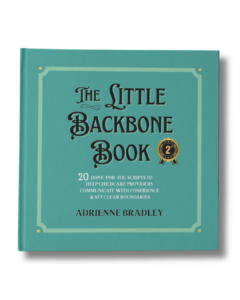
Inside are 20 done-for-you scripts for those uncomfortable childcare conversations—the ones where you know what needs to be said but aren’t quite sure how to say it without sounding harsh, apologetic, or uncertain.
Think of it as a little bit of backup for the next time you need to say, “Here’s what needs to happen going forward.”
You Can Set Daycare Parent Boundaries
You don’t need a bigger backbone. You may just need better words.
Clear communication gets easier when you aren’t inventing the words while a parent is standing in your doorway.
Decide what your boundaries are. Put them in writing. And give yourself permission to communicate them calmly, kindly, and confidently.
Because protecting the way your childcare business operates isn’t separate from being a caring provider.
It’s part of it.