
Running a successful childcare program takes far more than caring for children—it also means understanding the financial side of your business. Yet for many providers, daycare business finances can feel overwhelming, leaving them unsure whether they’re truly making a profit or simply staying busy. In this article, I’ll answer some of the most common questions childcare providers ask, including why it’s important to track income and expenses, how to know if your daycare is profitable, whether it’s time to raise your rates, which expenses you should be monitoring, and the easiest way to organize your finances. I’ll also walk you through a simple real-world example that shows how knowing your numbers can completely change the way you make business decisions. If you’re ready to stop guessing and start growing your childcare business with confidence, you’re in the right place.
The Biggest Financial Mistake I Made as a Childcare Provider (And How Finally Knowing My Numbers Changed Everything)
There was a time when you could have asked me how my childcare business was doing, and I would have confidently answered, “Great!”
After all, my enrollment was full. Parents were paying tuition. Every day was busy. Bills were getting paid. From the outside, everything looked like a successful business.
But if you had asked me a few simple questions, I probably would have stared at you with a blank look.
How much profit did you make last month?
What were your biggest business expenses?
Did you earn more this month than you did last month?
Could you comfortably afford a new piece of playground equipment?
The truth is…I had no idea.
Like many childcare providers, I spent my days caring for children, planning activities, communicating with parents, preparing meals, cleaning, and keeping up with licensing requirements. By the time the day was over, I was exhausted. Looking at financial reports was the last thing on my mind.
For years, I floated along hoping everything was working because the bank account wasn’t empty.
Looking back, I realize I wasn’t truly managing my business—I was simply operating it.
Everything changed once I started paying attention to my numbers.
I wasn’t just working hard anymore. I was making informed decisions.
And that changed everything.

Why Is It Important to Track Daycare Income and Expenses?
Many childcare providers don’t go into business because they love spreadsheets or bookkeeping. We start our businesses because we love working with children and making a difference in families’ lives.
But here’s something I’ve learned after years in business:
GET A PRINTABLE AD-FREE VERSION OF THIS BLOG POST HERE FOR ONLY $3!
Want a super handy, printer-friendly version of this blog post—without all the ads? Grab it for just $3!
When you download this printable guide, you’ll get all the information from this post, plus the convenience of having everything in one place. No more scrolling through pages or trying to remember where you saw that key detail! *Of course, grabbing the printable is totally optional—you can still follow along right here on the blog. But if you love a good shortcut (and who doesn’t?), this one’s for you! Just CLICK HERE!
A caring heart and a healthy business are not mutually exclusive—you need both.
Tracking your income and expenses isn’t about becoming an accountant. It’s about understanding what’s happening inside your business.
When you know how much money is coming in and exactly where it’s going, you can make decisions based on facts instead of feelings.
You’ll know whether you’re growing, maintaining, or quietly losing money without even realizing it.
Knowledge gives you confidence, and confidence helps you become a stronger business owner.
Related Reading:
- How To Know If Your Childcare Rates Are Too Low
- Childcare Pricing Strategies: How to Stop Undercharging and Start Thriving
How Do I Know If My Daycare Is Making a Profit?
This is one of the most important questions every provider should be able to answer.
Many of us look at our checking account and assume that if there’s money available, we’re doing well.
Unfortunately, that’s not always true.
Profit isn’t simply the money left in your bank account.
Profit is what’s left after you’ve paid for food, supplies, curriculum, utilities, insurance, licensing expenses, cleaning products, professional development, and every other cost of running your childcare business.
Without tracking these numbers consistently, it’s easy to underestimate your expenses and overestimate your profits.
When you know your true profit, you can:
- Feel more confident about the future of your business.
- Make smarter financial decisions.
- Plan for future expenses.
- Save for improvements.
- Reduce unnecessary spending.
A Simple Example
Let’s look at a fictional childcare provider named Sarah.
Sarah operates a licensed family childcare program and has a full enrollment. Every month, she collects $6,500 in tuition.
At first glance, she feels pretty good about that number.
After all, $6,500 sounds like a successful business.
But let’s take a closer look at her monthly expenses.
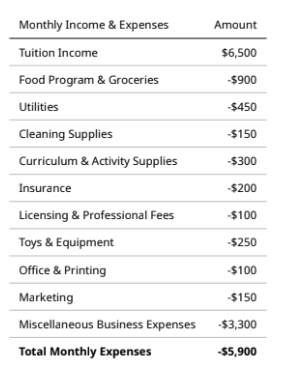
After all of her business expenses are paid, Sarah has $600 left.
That’s her profit.
Now imagine Sarah has been thinking about raising her tuition by $100 per child per month, but she’s nervous about how parents might respond.
Because she’s tracking her numbers, she realizes something important:
Her expenses have steadily increased over the past two years, but her tuition hasn’t.
Instead of making a decision based on emotion, she can make one based on facts.
Even a modest tuition increase could improve her monthly profit and create room to:
- Replace worn-out toys and equipment.
- Invest in new curriculum materials.
- Build an emergency savings cushion.
- Pay herself more consistently.
- Reduce financial stress.
Without tracking her income and expenses, Sarah might have continued believing her business was “doing fine” simply because money was still coming into the bank.
Knowing her numbers gave her something much more valuable than a spreadsheet.
It gave her confidence.
And confidence is one of the most powerful tools a business owner can have.
Should I Raise My Daycare Rates?
As we head into the fall enrollment season, this question is on many providers’ minds.
The answer isn’t simply “yes” or “no.”
The better answer is this:
Know your numbers first.
If your expenses have increased but your tuition hasn’t, a rate increase may absolutely be appropriate.
But rather than making that decision based on emotion or comparing yourself to other providers, use your own financial information.
When you understand your monthly income, expenses, and profit, you can confidently determine whether your current rates are supporting the business you want to build.
Raising your rates becomes less about asking parents for more money and more about ensuring your business remains healthy and sustainable for years to come.
Let’s make your childcare program even more amazing together! CLICK HERE to see how Adrienne can help you tackle the toughest challenges in your childcare business, boost your growth, and set you on the path to success.
What Expenses Should a Daycare Track?
This is another area where many providers unintentionally lose money.
Some of the most common business expenses include:
- Food and snacks
- Curriculum and activity supplies
- Arts and crafts materials
- Toys and educational resources
- Cleaning supplies
- Utilities
- Insurance
- Licensing fees
- Professional memberships
- Office supplies
- Marketing
- Equipment and furniture
- Repairs and maintenance
Even small purchases add up over time.
Tracking them consistently helps you understand where your money is being invested and whether there are opportunities to improve your profitability.
How Do Successful Childcare Businesses Manage Their Money?
Successful providers aren’t necessarily the ones with the biggest enrollments.
They’re the ones who understand their businesses.
They regularly review their finances.
They set monthly goals.
They monitor their income.
They watch their expenses.
They identify trends before they become problems.
Most importantly, they stop guessing.
Financial organization isn’t about perfection.
It’s about building habits that allow you to make better business decisions month after month.
Those small habits eventually become significant advantages.
What Is the Easiest Way to Organize Daycare Finances?
The easiest system is the one you’ll actually use consistently.
That’s exactly why I created this week’s Adrienne’s Weekly Resource Pick™—the Daycare Money Manager.
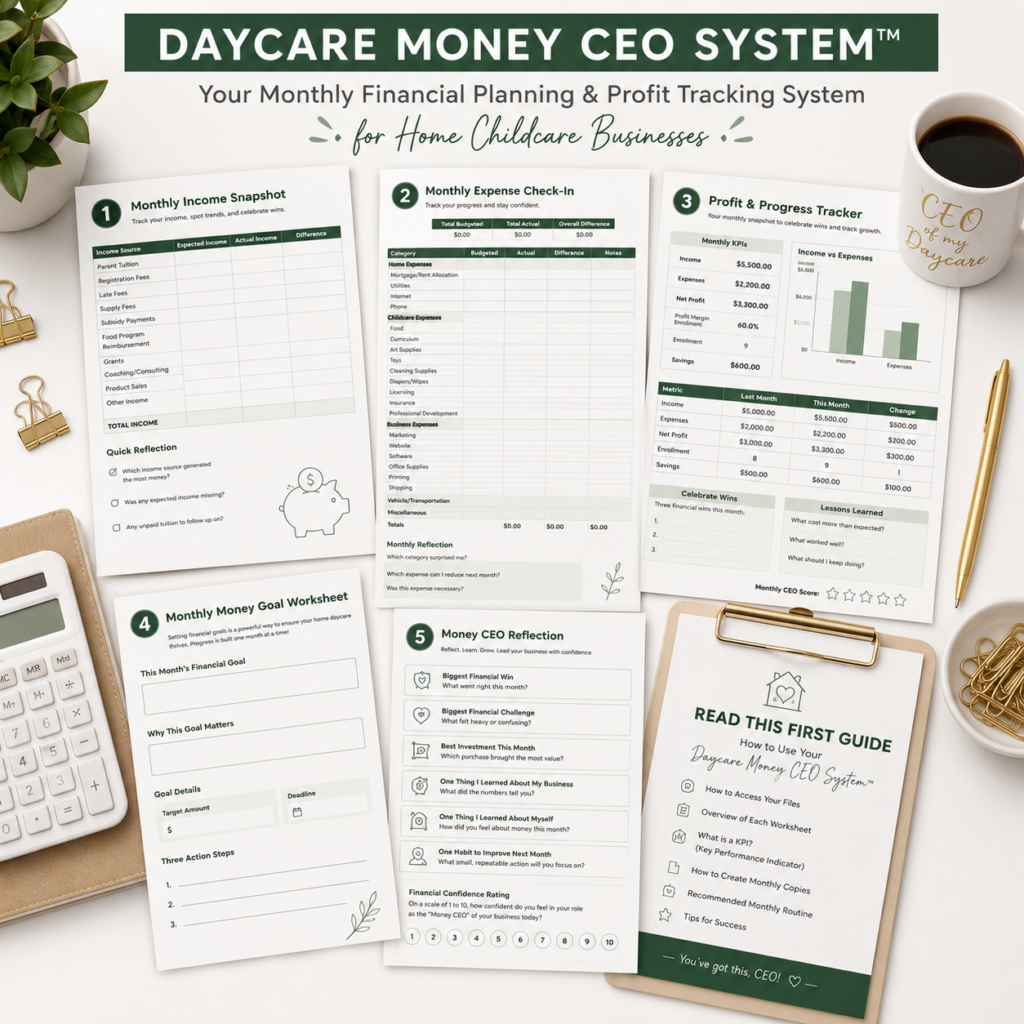
Instead of complicated bookkeeping software or confusing spreadsheets, this resource was designed specifically for childcare providers.
Inside you’ll find tools to help you:
- Capture your monthly income at a glance.
- Track business expenses without the overwhelm.
- Monitor your profit and progress.
- Set monthly financial goals.
- Better understand the overall health of your business.
Whether you’re preparing to raise your tuition, planning for fall enrollment, or simply trying to feel more in control of your finances, the Daycare Money Manager gives you a practical place to start.
You don’t have to become a financial expert.
You simply need a system that helps you understand your business one month at a time.
This Week’s Resource Pick™
For this week only, the Daycare Money Manager is available for just $5.99.
After this week’s promotion ends, it will return to its regular price of $27.
If you’ve ever wondered where your money goes each month…
If you’ve questioned whether your daycare is truly profitable…
Or if you’ve been putting off getting organized “until things slow down”…
Consider this your sign to start today.
The best time to understand your business finances was years ago.
The second-best time is this week.
Because your childcare business deserves more than your hard work.
It deserves the confidence that comes from knowing your numbers.