
When enrollment starts changing, it can be tempting to loosen the rules a little just to keep families happy—but that’s exactly when strong childcare policies matter most. Clear policies help protect your income, your time, and your boundaries while giving parents a better understanding of how your program operates. In this post, we’re talking about why those policies become even more important when enrollment feels uncertain, how to communicate them more effectively, and why your parent handbook can be one of the most powerful tools in your childcare business.
How to Get Parents to Follow Childcare Policies
There was a time in my childcare business when losing a family felt like a REALLY big deal.
And if you’ve ever had an empty childcare spot sitting there while the bills kept rolling in, you probably know exactly what I mean.
When enrollment is good and you have families calling, emailing, and asking to be added to your waiting list, it’s a whole lot easier to say:
“I’m sorry, but that’s my policy.”

But when enrollment slows down?
Whew.
Suddenly, you can start looking at those policies a little differently.
Maybe a parent needs to pay tuition a few days late.
“Okay…just this once.”
Maybe they continually arrive after your closing time.
“I really don’t want to make a big deal out of it.”
Maybe they don’t want to pay for a holiday closure.
“I don’t want them to leave.”
Before you know it, you’re bending policies you created for a reason because you’re afraid of losing the income.
GET A PRINTABLE AD-FREE VERSION OF THIS BLOG POST HERE FOR ONLY $3!
Want a super handy, printer-friendly version of this blog post—without all the ads? Grab it for just $3!
When you download this printable guide, you’ll get all the information from this post, plus the convenience of having everything in one place. No more scrolling through pages or trying to remember where you saw that key detail! *Of course, grabbing the printable is totally optional—you can still follow along right here on the blog. But if you love a good shortcut (and who doesn’t?), this one’s for you! Just CLICK HERE!
I’ve been in this business long enough to understand how easy it is to get there.
But here’s what I’ve learned:
The times when your childcare business feels uncertain are actually the times when your childcare policies matter MOST.
Enrollment Is Changing for Childcare Providers
There’s no denying that the childcare landscape is changing.
Providers are dealing with increased competition, changing family needs, rising operating costs, and in many areas, expanded public preschool and Universal Pre-K programs.
That can mean fewer older preschoolers enrolling in family childcare programs.
And when you have openings you aren’t used to having, it’s easy to slip into survival mode.
You start thinking:
“I can’t afford to lose this family.”
And sometimes that thought leads us to tolerate things we wouldn’t normally tolerate.
But I want you to remember something:
An enrollment problem should not become a policy problem.
Lower enrollment doesn’t mean your business suddenly doesn’t need boundaries.
In fact, the opposite may be true.
When every tuition dollar matters, you need your policies protecting your time, your income, and your business more than ever.
Strong Childcare Policies Help Protect Your Income
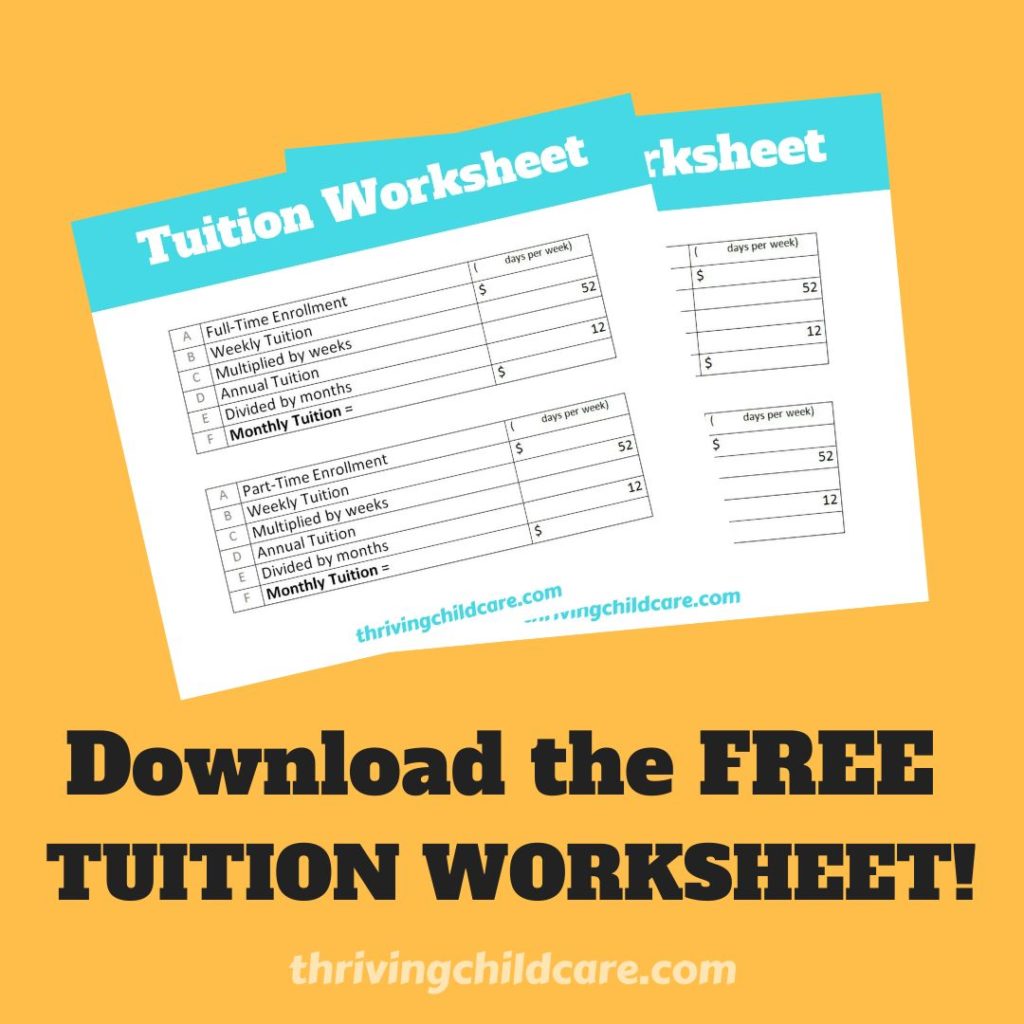
Let’s talk about tuition.
If your policy says tuition is due on Friday but families regularly don’t pay until Tuesday, what happens?
You still have expenses.
You still need groceries.
You still have utilities.
You still have insurance.
You still have supplies.
Your bills don’t wait because a parent forgot to pay you.
The same thing applies to late fees, deposits, vacation policies, paid closures, and termination notices.
These policies aren’t there because you’re trying to make life difficult for families.
They’re there because you’re operating a business.
Clear financial childcare policies help make your income more predictable.
And when enrollment is changing, predictable income becomes even more important.
Related Reading:
Let’s make your childcare program even more amazing together! CLICK HERE to see how Adrienne can help you tackle the toughest challenges in your childcare business, boost your growth, and set you on the path to success.
Your Childcare Policies Also Protect Your TIME
Money isn’t the only thing we’re protecting.
Let’s say your childcare closes at 5:30.
But one parent regularly arrives at 5:40.
Then 5:45.
Then occasionally 6:00.
You might think:
“It’s only 15 minutes.”
But multiply those 15 minutes over weeks and months.
That’s YOUR time.
And because childcare is such a personal business, providers sometimes have a hard time drawing that line.
We care about our families.
We understand that traffic happens.
We understand that jobs run late.
We understand that life happens.
But understanding someone’s circumstances doesn’t mean you can’t have boundaries.
You can be compassionate AND have policies.
Those two things aren’t opposites.
“But I Told Them That…”
If you’ve been following me this week, you’ve probably heard me say this already:
How many times have you found yourself saying:
“But I told them that when they enrolled!”
Here’s the problem.
Parents are receiving a LOT of information when they enroll.
They’re completing paperwork.
They’re learning your routines.
They’re figuring out drop-off and pickup.
They’re remembering what to pack.
They’re trying to learn your payment schedule.
They’re meeting you.
Their child is adjusting.
They’re adjusting.
So even though you may have verbally explained something six months ago, that doesn’t necessarily mean they’re going to remember it.
That’s why important childcare policies need to be IN WRITING.
Instead of:
“But I told you…”
you want to be able to say:
“Absolutely. Let’s take a look at the policy in your parent handbook.”
That’s a completely different conversation.
[FREE DOWNLOAD] Here Are The 10 Must-Have Daycare Templates
Your Parent Handbook Isn’t Just Paperwork
I think sometimes providers look at their handbook as another document they’re supposed to have.
But I want you to start thinking about it differently.
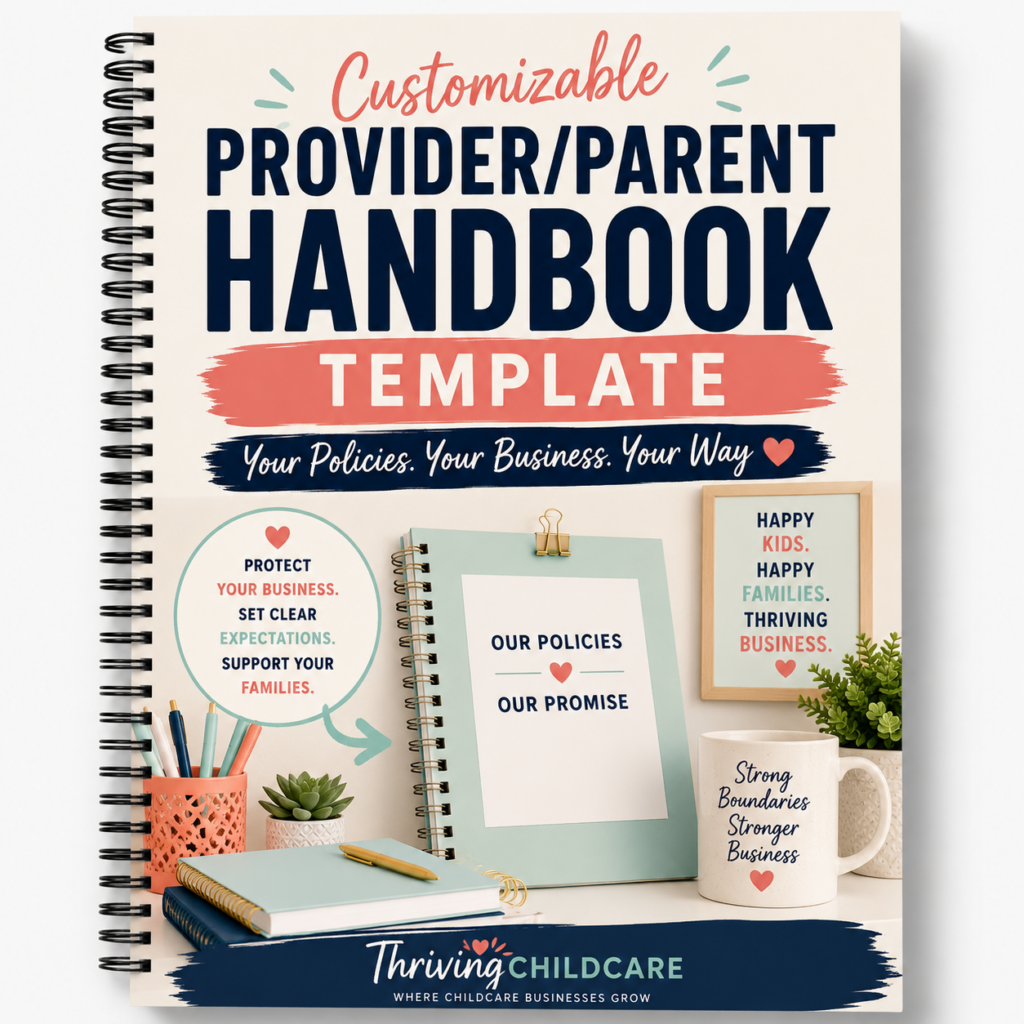
Your parent handbook is a business tool.
It helps explain:
- How your childcare program operates
- What families can expect from you
- What you expect from families
- When and how tuition is paid
- Your operating hours and closures
- Health and safety expectations
- How you communicate with families
- Enrollment and termination procedures
- Parent responsibilities
- Other important policies unique to your program
And most importantly, it gives everyone something to refer back to.
That doesn’t mean parents will suddenly LOVE every policy.
They won’t.
But there is a big difference between:
“I didn’t know that was your policy.”
and:
“I know that’s the policy. I just don’t like it.”
The second one is much easier to address.
Don’t Let an Empty Spot Make You Abandon Your Standards
This may be the most important thing I tell you today.
If your enrollment has changed, don’t panic and start dismantling the systems that helped you build your business.
Instead, take a good look at them.
Maybe some policies DO need to change.
Businesses evolve.
Families’ needs change.
The childcare industry changes.
And there’s absolutely nothing wrong with updating a policy that no longer serves your business.
But there’s a difference between intentionally changing a policy and repeatedly ignoring one because you’re afraid someone will leave.
Ask yourself:
Does this policy still make sense for my business?
If yes, communicate it clearly and enforce it consistently.
If no, change it.
That’s running a business intentionally instead of running it out of fear.
When Was the Last Time You Actually Read Your Handbook?
Here’s your homework.
Pull out your current Provider/Parent Handbook and read it from beginning to end.
Ask yourself:
Does this document reflect the childcare business I’m running TODAY?
Are the rates current?
Are your hours correct?
Are your closure policies clear?
Have situations come up over the past year that made you think:
“I need to put THAT in my handbook!”
Did you ever actually add it?
And here’s the big question:
Would you confidently hand your current handbook to a brand-new family tomorrow?
If the answer is no, it’s probably time for a refresh.
Don’t Have a Handbook—or Don’t Want to Start Over?
That’s exactly why I chose the Customizable Provider/Parent Handbook Template as this week’s Adrienne’s Weekly Resource Pick™.
You don’t have to sit in front of a blank Google Doc wondering:
“Okay…what am I supposed to put in this thing?”
I’ve already given you a customizable framework that you can adapt to your own childcare program.
Review it.
Customize it.
Add your specific policies.
Remove what doesn’t apply.
Make it YOURS.
And then actually use it as the business tool it’s intended to be.
The template is normally $37, but as this week’s Adrienne’s Weekly Resource Pick™, you can get it for:
Just $27 through Sunday (8/23/26) at midnight.
[GET THE CUSTOMIZABLE PROVIDER/PARENT HANDBOOK TEMPLATE FOR $27 →]
After that, it returns to its regular $37 price.
Your Business Still Deserves Boundaries
If enrollment is changing in your area, I understand why that can feel scary.
But an empty childcare spot doesn’t mean you have to accept every behavior, abandon your policies, lower your standards, or operate your business from fear.
You built your policies for a reason.
Make sure they’re still right for your business.
Make sure they’re clearly communicated.
Put them in writing.
And then give yourself permission to stand behind them.
Because you can love your daycare families AND have boundaries.
You can be compassionate AND enforce your policies.
You can adapt to a changing childcare industry AND protect the business you’ve worked so hard to build.
Those things can absolutely coexist.