

One of the most stressful parts of running a childcare business is trying to keep your enrollment spots filled.
A family gives notice.
A child leaves for kindergarten, Transitional Kindergarten, or Universal Preschool.
Someone moves, changes jobs, or suddenly needs a different schedule.
And before you know it, you’re searching for an old flyer, posting “Now Enrolling,” responding to inquiries, and trying to remember the name of that parent who contacted you three months ago.
Meanwhile, the child’s final day keeps getting closer—and so does the day when the tuition connected to that space disappears. 😩
But enrollment shouldn’t begin after the goodbye.
An early enrollment childcare program helps you look ahead, identify openings you reasonably expect to have, and begin connecting with prospective families before those spaces are actually empty.
This is more than putting someone’s name on a waitlist and hoping they still need care six months from now.
It’s about creating an intentional process for:
- Tracking when spaces may become available
- Promoting future openings
- Organizing interested families
- Following up with prospective parents
- Communicating how your early-enrollment process works
- Preparing for the transition from one enrolled family to the next
I originally developed my own pre-enrollment program to solve a very specific problem involving future infant openings. But over the years, I’ve realized that the same basic idea can help providers prepare for many types of predictable enrollment changes.
Today, children may leave for TK, Universal Preschool, kindergarten, a family move, or another care arrangement. You cannot control every decision a family makes—but you can stop waiting until the space is already empty to think about what happens next.
In this updated guide, I’m going to share how my original Pre-Enrollment Program began, how it worked, and how you can adapt the idea to create an early-enrollment system that makes sense for your childcare business today.
READY TO STOP STARTING FROM ZERO?
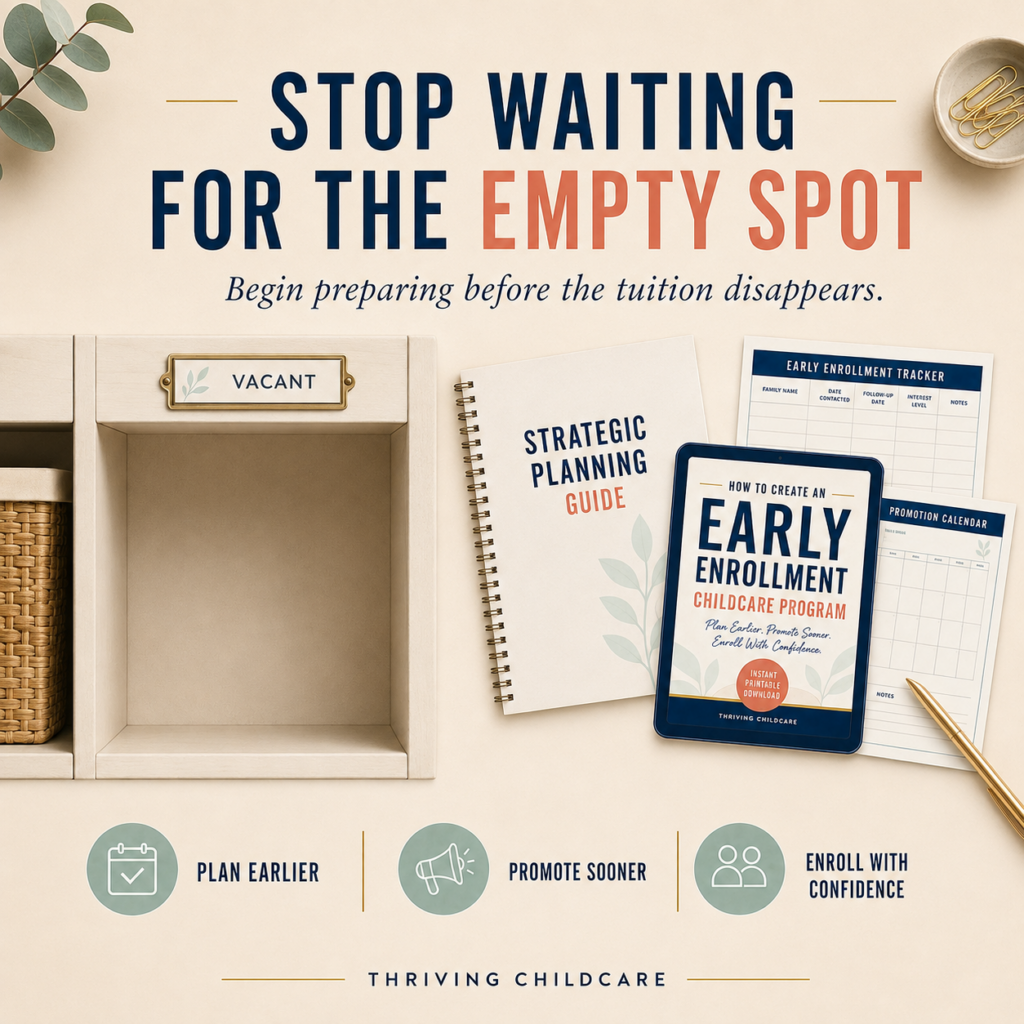
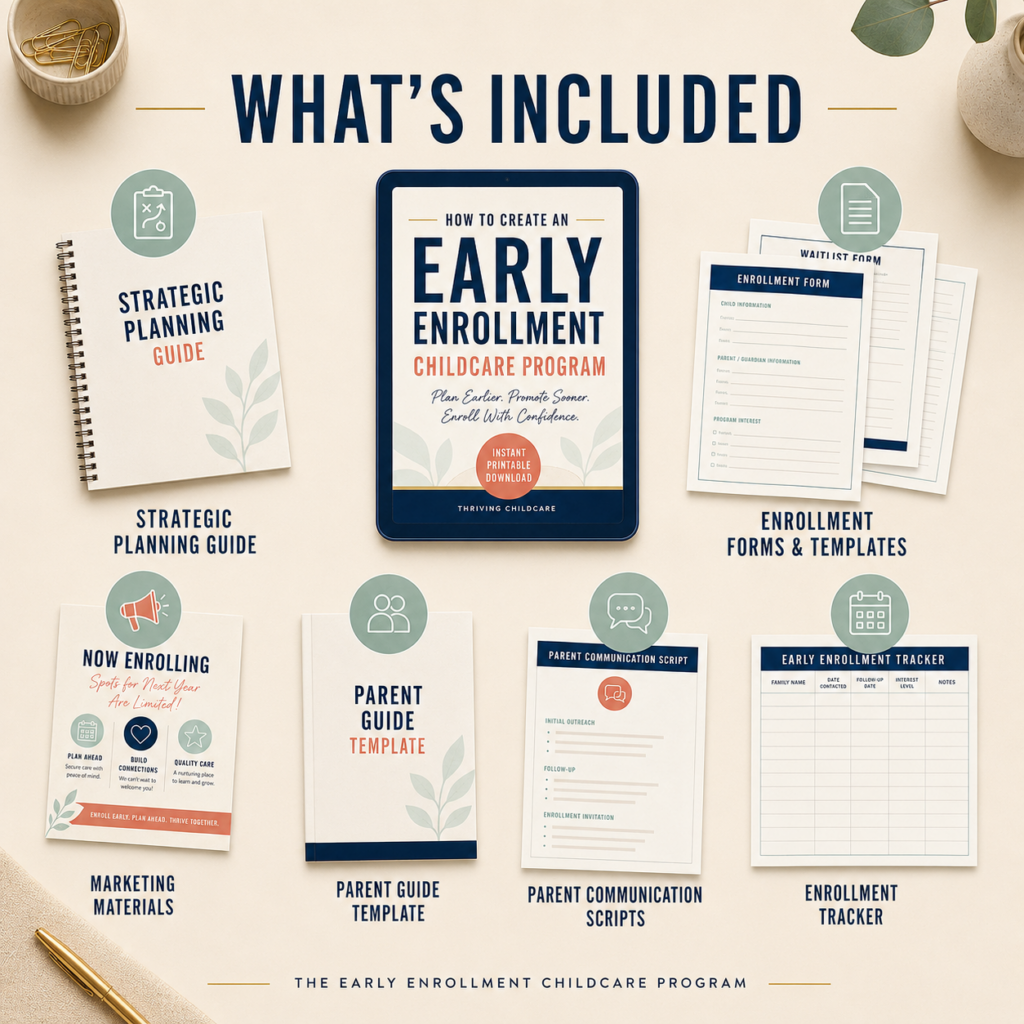
The Early Enrollment Childcare Program gives you a strategic planning guide, enrollment forms and templates, marketing materials, a parent guide template, communication scripts, and an enrollment tracker to help you build your own repeatable process.
👉 SEE EVERYTHING INCLUDED IN THE EARLY ENROLLMENT CHILDCARE PROGRAM
Instant printable download created specifically for childcare providers.
Originally published February 24, 2016. Updated September 2026.
Fill Future Openings With an Early Enrollment Childcare Program
Years ago, I remember feeling frustrated by childcare spaces that I just couldn’t seem to fill at the right time.
The strange part was that I was receiving calls from interested parents.
The problem wasn’t necessarily a lack of demand.
It was the timing.
Many of the calls came from expectant parents who knew they would need infant care—but not for several months. Under the licensing rules that applied to my program, I could only enroll a limited number of infants at one time, so those spaces were especially valuable.
At the time, I would usually tell expectant parents to call me again after their babies were born. Hopefully, I would have an opening when they were ready to return to work.
But “hopefully” wasn’t a very comforting answer for them.
These parents were trying to make one of the most important childcare decisions they would ever make. They wanted to know that their baby would have a safe, loving place to go when maternity leave ended—not restart their search while caring for a newborn and watching their return-to-work date get closer.
And honestly, telling them to call back later wasn’t working particularly well for me either.
I was turning away families who already liked my program simply because the space they needed wasn’t available yet.
Then, months later, when an infant space did become available, I might have to begin my search from the beginning—even though interested parents had already contacted me.
The problem wasn’t always finding prospective families.
The problem was connecting the right future family with the right future opening at the right time.
I began wondering whether there was a better way to bridge the gap between:
“I don’t have an opening today”
and
“I know I’m going to have an opening later.”
As it turned out, the idea that helped me solve that problem didn’t begin with a complicated business plan, a fancy marketing strategy, or one of those dramatic lightbulb moments.
It began with one expectant mother asking me a very simple question.
What Is an Early Enrollment Childcare Program?
An early enrollment childcare program is a structured process that allows a provider and an approved prospective family to plan for a specific future childcare opening before care officially begins.
Depending on how the provider sets it up, the process may include:
- An anticipated opening date
- The child’s expected first day of care
- A childcare application or enrollment form
- A tour and family interview
- Written early-enrollment terms
- A reservation or holding fee, where permitted
- Scheduled communication and follow-up before care begins
- A plan in case the family’s needs or the expected opening date change
The purpose is not to make promises about spaces you don’t reasonably expect to have.
It’s to connect a family who needs care in the future with an opening you already anticipate having.
For the family, that can provide peace of mind.
For the provider, it can create a more organized transition between enrollments and reduce the amount of time a space remains unfilled.
Born out of a Need
I wish I could say the idea came to me during one of those dramatic “ah-ha!” business moments.
It didn’t.
A future childcare client suggested it to me.
This mother was pregnant with her first child. She had a demanding work schedule and already knew that changing it would not be an option. She wanted to choose her childcare provider well before her maternity leave ended.
More importantly, she wanted to know that the provider she chose would actually have room for her baby when she needed to return to work.
Then she asked me a question I had never been asked before:
“Would you hold the spot if I paid for it?”
I perked up.
Wait—what?!
She explained that she was willing to pay in advance to reserve the future infant space. That way, she wouldn’t have to spend her maternity leave calling childcare programs, scheduling tours, and hoping she found someone she trusted before returning to work.
Now that was some serious planning!
And the more I thought about it, the more the idea made sense for both of us.
She would have the peace of mind of knowing where her baby would receive care.
I would have a family prepared to begin when the anticipated infant opening became available.
And because I was planning around a future vacancy—not leaving a currently available space empty—the arrangement could help me prepare for my next enrollment without immediately sacrificing the income from that space.
Of course, I said yes.
It felt a little like I was expecting a baby too—only better because there would be no labor pains involved. 😂
That first arrangement helped me recognize a need I hadn’t considered before.
Prospective families didn’t always need care today.
Sometimes they needed a reliable way to plan for care several months from now.
And I needed a better response than:
“Call me back later and hopefully I’ll have room.”
As more families contacted me with similar needs, I began working out the details. I considered how far in advance I was willing to reserve a space, what information I needed from parents, how reservation payments would work, what would happen if plans changed, and which expectations needed to be placed in writing.
Eventually, I gave the service a name:
PEP—MY PRE-ENROLLMENT PROGRAM
Cute, right? PEP. 😄
What started as one expectant mother’s request became a repeatable childcare business service that helped families plan ahead and helped me prepare for future openings more intentionally.
Important: An early-enrollment arrangement should always be documented clearly and should comply with your licensing requirements, subsidy rules, contract terms, insurance requirements, and applicable state and local laws. What worked in my program may need to be adjusted for yours.
Related Reading:
When Should You Begin Early Enrollment?
The best time to think about your next enrollment is before you have an empty space.
That means regularly looking ahead at your enrollment calendar instead of waiting until a parent hands you a notice.
Start by identifying childcare openings you can reasonably anticipate during the next three to twelve months.
Those openings might result from:
- A child leaving for TK, Universal Preschool, or kindergarten
- A child aging into another licensing or capacity category
- A family providing advance notice
- A family moving or changing work schedules
- A child transitioning from full-time to part-time care
- A planned change to the ages or schedules you serve
- A known seasonal opening, such as summer or school-break care
- An approved increase in your program’s licensed capacity
Of course, not every anticipated transition will happen exactly when expected. A family may change its plans, a school start date may shift, or a child may remain in your program longer than originally discussed.
That is why I call it an anticipated opening until the details are confirmed.
Look Ahead Before You Advertise
In my original Pre-Enrollment Program, I kept track of when children would move out of my licensed infant category. That helped me estimate when another infant space might become available.
Once I identified the anticipated month, I could work backward.
For example, if I expected an infant opening in June, I didn’t wait until June to start looking for a family.
I began connecting with expectant parents whose babies would likely need care around that time.
The exact timeline will depend on:
- The type of opening
- The age of the child you hope to enroll
- How early families in your area search for care
- The length of your application and tour process
- Whether you offer a formal reservation arrangement
- How certain you are about the anticipated vacancy
Infant care may require a longer lead time because many parents begin searching during pregnancy.
A preschool, school-age, or part-time opening may require a different timeline.
The goal is not to advertise every possible opening a year in advance.
The goal is to give yourself enough time to find the right family before the space—and its tuition—are gone.
Promote the Future Opening Clearly
Once you have identified a likely opening, create a message that speaks directly to the family who will need it.
Your announcement should clearly explain:
- The age group you expect to serve
- The anticipated availability date
- The schedule being offered
- Your general location
- What makes your program valuable
- How the family can request information or apply
- Whether this is an inquiry, waitlist, or formal early-enrollment opportunity
- What the next step will be
Avoid vague posts that simply say:
“NOW ENROLLING! CALL FOR DETAILS!”
That message doesn’t tell parents whether the opening fits their child, schedule, or timeline.
It also gives them very little reason to choose your program over the seventeen other “Now Enrolling” posts they scrolled past that morning. 👀
Instead, try something more specific:
FUTURE CHILDCARE OPENING
We anticipate having an opening for a [CHILD’S AGE/AGE GROUP] beginning [MONTH/YEAR].
Our home childcare program offers [HOURS/SCHEDULE], a small group environment, consistent care, [MEALS/ACTIVITIES/OTHER BENEFIT], and a warm, home-like setting for children.
Families who expect to need care around this time are invited to contact us now to learn about our early-enrollment process, schedule a tour, and determine whether our program may be a good fit.
Contact: [EMAIL/PHONE/WEBSITE]
Notice that this language says the opening is anticipated.
It creates interest without promising a space before you have confirmed that the opening, family, schedule, and enrollment arrangement all work.
You can share your future-opening announcement through:
- Your childcare website
- Your email list
- Social media
- Local parent groups, where permitted
- Childcare directories
- Community bulletin boards
- Referral partners
- Current and former childcare families
- Your inquiry or waiting list
And don’t overlook the people who have already contacted you.
A parent who inquired several months ago may still need care—but only if you kept enough information to follow up with them.
That is where an organized enrollment tracker becomes extremely useful.
NEED HELP CREATING YOUR EARLY-ENROLLMENT SYSTEM?
The Early Enrollment Childcare Program includes planning guidance, enrollment forms and templates, marketing materials, parent communication scripts, a parent guide template, and an enrollment tracker.
Use it to prepare for future openings without recreating your process every time a family gives notice.
👉 [EXPLORE THE EARLY ENROLLMENT CHILDCARE PROGRAM]
Related Reading:
- Universal Preschool and Childcare Business Adaptation: 5 Smart Strategies
- What Can You Do After Childcare? 25 Amazing Career Paths You May Already Be Qualified For
Put Your Early-Enrollment Terms in Writing
Once a family is ready to reserve a future opening, the arrangement needs to move beyond a friendly conversation.
Put the details in writing.
Your regular childcare contract may explain what happens after care begins, but an early-enrollment arrangement creates questions that occur before the child’s first day.
A separate agreement or clearly written addendum should address details such as:
- The child’s name and age or expected birth date
- The anticipated opening date
- The expected first day of care
- The schedule and type of space being reserved
- Any application, enrollment, reservation, or holding fees
- When payments are due
- Whether payments are refundable or applied to future tuition
- When regular tuition payments will begin
- What happens if the family’s start date changes
- What happens if the anticipated opening date changes
- What happens if the family no longer needs care
- What happens if the provider cannot offer the expected space
- How long the reservation arrangement remains valid
- How and when both parties must communicate changes
This is not the place for vague language like:
“We’ll work it out if anything changes.”
Because something will probably change. Babies arrive early. Maternity leaves get extended. Work schedules change. Current families postpone their departure. Life will absolutely try to climb into your nice, neat enrollment calendar and rearrange the furniture. 😂
Think through those possibilities before accepting money or promising a future space.
A Reservation Fee Does Not Guarantee the Family Will Enroll
In my original Pre-Enrollment Program, I required parents to pay a monthly fee to reserve the anticipated opening.
The purpose was to create a real commitment from both sides.
However, I would no longer say that a fee ensures a family will not change its mind.
It doesn’t.
A parent can still move, change jobs, extend maternity leave, choose another provider, or experience a completely unexpected change in circumstances.
A reservation payment may make the arrangement more serious, but it cannot eliminate every enrollment risk.
That is why your agreement should clearly explain what happens to the money and the reserved space if either party’s plans change.
Also, be careful about using terms such as deposit, registration fee, enrollment fee, and holding fee interchangeably. Those words may carry different expectations or legal implications.
Before creating your fee policy:
- Review your state and local childcare requirements
- Contact your licensing agency when necessary
- Check your insurance requirements
- Confirm the rules of any subsidy or alternative-payment program you accept
- Make sure your regular contract and early-enrollment agreement do not contradict each other
- Consider having your agreement reviewed by a qualified local professional
For example, California’s Department of Social Services has stated that providers generally establish their own childcare payment practices. However, providers who contract with subsidized programs are advised to contact those programs directly for payment guidance.
That does not mean every fee or refund policy is automatically appropriate.
Your business practices still need to comply with the rules and agreements that apply to your individual program.
Am I Losing Income by Holding a Future Childcare Space?
This is one of the first questions providers ask:
“If I reserve a space for a future family, am I giving up income while I wait for the child to begin?”
The answer depends on whether the space is a future opening or a currently empty opening.
In my original situation, I had mapped out when a currently enrolled child would move out of my infant category.
The future infant space wasn’t sitting empty while I waited for the new baby.
It was still being used by a currently enrolled child.
So, at that point, I wasn’t sacrificing the full tuition from an available space. I was preparing a replacement enrollment for a space I expected to become available later.
That is very different from holding a space that is already vacant.
If you have an empty full-time space today, but agree to hold it for a family that will not begin for another three months, you may be turning away families who could start sooner and pay full tuition immediately.
A small reservation payment may not make up for that lost income.
Before agreeing to hold any space, ask yourself:
- Is this space currently occupied or already empty?
- How certain is the anticipated opening date?
- How long does the family want me to hold it?
- What tuition could the space generate during that time?
- Would I have a reasonable chance of filling it with someone who could start sooner?
- Does the reservation payment fairly compensate the business for the commitment?
- What happens if the family delays or cancels?
- What happens if my expected opening is delayed?
Do the math before you make the promise.
Early enrollment should help reduce income gaps—not accidentally create a larger one.
The best arrangement is one that makes sense for the family, protects the provider’s business, and clearly explains what both parties can expect.
Related Reading:
- 10 Child Care Services You Can Offer
- How to Stand Out in A Crowded Daycare Market
- The Best Ways To Market With A Daycare Website
How to Set Up an Early Enrollment Childcare Program
Creating an early enrollment childcare program does not have to be complicated.
But it should be more organized than scribbling a parent’s name and due date on the back of an envelope and hoping you can find it again six months later. 😂
Here is a practical process you can use.
Step 1: Map Your Expected Openings
Review your current enrollment and identify spaces you reasonably expect to become available during the next three to twelve months.
Record:
- The anticipated availability date
- The age group you expect to serve
- The schedule that may become available
- Why you expect the opening
- How certain the transition is
- When you should begin marketing it
Remember to confirm that the anticipated enrollment will fit your licensed capacity, age limitations, ratios, staffing, and insurance requirements.
Step 2: Decide What Your Early-Enrollment Program Will Offer
Determine exactly what a family receives by participating.
Will they receive:
- Priority consideration for an anticipated opening?
- A scheduled tour and interview?
- The opportunity to complete enrollment early?
- A future space reserved under a written agreement?
- Regular updates before the start date?
- A guaranteed start date only after specific conditions are met?
Be clear about what you are—and are not—promising.
“Early enrollment” should have a specific meaning inside your business.
Step 3: Establish Your Policies Before Speaking With Families
Decide how your process will work before an interested parent asks you twelve questions while you are warming bottles, serving lunch, and trying to remember what you said to the last person. 😩
Your policies should address:
- How far in advance families may apply
- Which openings qualify
- Your application and approval process
- Tours and interviews
- Reservation or holding fees, where permitted
- Payment deadlines
- Refunds and cancellations
- Delayed or changed start dates
- Provider-initiated changes
- Communication expectations
- When regular tuition begins
- When an arrangement expires
Your answers should be consistent from one family to the next.
Step 4: Create the Forms and Communication Materials
Prepare the materials you will need before promoting the program.
These may include:
- An early-enrollment application
- A family-information form
- A written agreement or contract addendum
- A parent guide explaining the program
- A future-opening flyer
- Inquiry-response messages
- Follow-up emails or scripts
- An enrollment tracker
- A confirmation letter or welcome message
Having these materials ready helps your process feel intentional and professional.
It also prevents you from recreating everything every time another opening is expected.
Step 5: Promote a Specific Future Opening
Use clear language to describe:
- The anticipated opening date
- The age group
- The available schedule
- Your general location
- The benefits of your program
- Who should inquire
- What the next step will be
Parents should be able to quickly determine whether the opportunity may fit their needs.
Step 6: Screen Prospective Families Carefully
Early interest should not cause you to skip your normal enrollment process.
The family should still:
- Complete an inquiry or application
- Meet your basic eligibility requirements
- Review your program’s schedule and policies
- Participate in a childcare tour or interview
- Ask questions
- Determine whether your program is a good fit
- Provide any information required before acceptance
An anticipated opening is not a reason to enroll the first person who sends you a message.
You are still looking for the right family—not merely the fastest family.
Step 7: Confirm the Arrangement in Writing
Once you and the family decide to move forward, document the agreement.
Make sure both parties understand:
- What space is being planned or reserved
- The anticipated start date
- What payments are required
- What happens if plans change
- When the family must confirm its continued interest
- When regular enrollment documents and tuition become due
Give the family a copy and keep a copy with your business records.
Step 8: Track the Family and Schedule Follow-Ups
Do not accept a future enrollment and then disappear until the child’s expected first day.
Add the family to your enrollment tracker and schedule regular check-ins.
You may want to follow up:
- After the agreement is completed
- A few months before care begins
- When the opening becomes more certain
- Before final enrollment documents are due
- A few weeks before the first day
- Whenever either party reports a change
Consistent communication helps both sides prepare and gives you an opportunity to address changes before they become last-minute surprises.
Step 9: Keep a Backup Interest List
Even a well-planned future enrollment can change.
Continue keeping records of other suitable families who inquire about the same general timeframe.
This does not mean promising one opening to several families.
It means maintaining an organized list of prospective families you may contact if the original arrangement ends or another opening becomes available.
Step 10: Confirm the Transition Into Regular Care
Before the child begins, confirm:
- The final start date
- The approved schedule
- Tuition and payment dates
- Required enrollment documents
- Emergency and health information
- Orientation or transition plans
- Supplies the family should provide
- Your regular childcare policies
At that point, the family moves from your early-enrollment process into your regular enrollment and onboarding process.
DON’T WANT TO CREATE ALL OF THIS FROM SCRATCH?
The Early Enrollment Childcare Program includes the planning guidance, forms, templates, marketing materials, parent guide, communication scripts, and enrollment tracker you need to begin building your system.
Plan earlier. Promote sooner. Enroll with more confidence.
👉 GET THE EARLY ENROLLMENT CHILDCARE PROGRAM
Waitlist vs. Early Enrollment vs. Reserving a Childcare Space
A waitlist, an early-enrollment process, and a childcare-space reservation are related—but they are not the same thing.
Understanding the difference can help you communicate clearly with families and avoid making promises you never intended to make.

A Waitlist Records Interest
A waitlist is useful when a family wants care, but you do not currently have a suitable opening or cannot confidently predict when one will become available.
You may collect information such as:
- Parent and child names
- The child’s age
- The desired start date
- The schedule needed
- Contact information
- The date of the inquiry
- Notes about the family’s needs
Adding a family to your waitlist should not automatically mean that you have promised them the next opening.
It simply gives you an organized list of people to contact when something suitable becomes available.
Your waitlist policy should explain whether families are contacted in the order they inquired or according to other factors, such as age, schedule, sibling priority, and overall program fit.
Early Enrollment Moves the Family Into an Active Process
Early enrollment goes beyond recording someone’s name.
At this stage, you reasonably anticipate an opening that may match the family’s needs, and both sides begin determining whether the arrangement could work.
That may include:
- Providing information about the anticipated opening
- Reviewing the requested schedule
- Completing an application
- Conducting a tour or interview
- Discussing policies and tuition
- Checking whether the family is a good fit
- Explaining the steps required to move forward
- Scheduling future communication
A family may be participating in your early-enrollment process without having a formally reserved space yet.
This is why your communication needs to be precise.
Avoid saying:
“The spot is yours!”
unless you have actually completed the steps required to make that commitment.
A Reservation Formalizes the Arrangement
A childcare-space reservation is a more formal commitment involving a specific family, anticipated opening, and start date.
It should be supported by written terms explaining:
- What space is being reserved
- The anticipated availability date
- The family’s expected start date
- What conditions must be satisfied
- What payments are required, where permitted
- What happens if either party’s plans change
- When the reservation expires or transitions into regular enrollment
Even then, avoid using the word guaranteed unless your agreement truly allows you to make that promise under every circumstance described.
An anticipated opening can be delayed. Licensing or staffing circumstances can change. A family’s needs can change too.
Your written agreement should explain those possibilities instead of pretending they can never happen.
Which Process Should You Use?
Use a waitlist when:
- You do not currently have a suitable opening
- The family’s timeline is uncertain
- You cannot reasonably predict availability
- You want permission to contact the family later
Use early enrollment when:
- You reasonably anticipate a future opening
- The family’s needs may match it
- You are ready to begin screening, touring, and planning
- You want to keep communication active before the start date
Use a formal reservation arrangement when:
- The family has been approved
- You have identified a specific anticipated space
- Both parties understand the commitment
- The conditions have been placed in writing
- Any fee or payment arrangement is permitted and clearly explained
Don’t use the three terms interchangeably.
A parent should always understand whether she is simply waiting, actively preparing, or formally reserving a future childcare space.
Clear language protects the family’s expectations—and your childcare business.
Early Enrollment Can Create a Buzz Around Your Childcare Program
Offering families a way to plan for future care did more than help me prepare for upcoming vacancies.
It also created a sense of demand around my childcare program.
Former parents shared their experiences in local parent groups and told other families that they had been able to arrange care with me well in advance.
Prospective parents began learning that if they wanted a future infant space, they should contact me early.
That message was far more powerful coming from another parent than it would have been coming from me.
After all, I could tell everyone my program was in demand.
But when parents started telling other parents:
“You need to call her early if you want a spot,”
that created genuine word-of-mouth interest.
Eventually, I rarely had infant spaces available without a future family already being considered or prepared to begin.
I could even proudly tell prospective parents that some of the children in my program had been enrolled before they were born.
That didn’t mean every future enrollment worked perfectly or that every anticipated opening was filled without interruption.
It meant I had stopped treating each vacancy as a complete surprise.
I was paying attention, planning ahead, communicating with families, and creating a process I could use again.
Fill a Need—and Strengthen Your Childcare Business
Before that first expectant mother asked me to reserve a space, I hadn’t considered offering anything beyond my usual full-time and part-time childcare arrangements.
Her request taught me an important business lesson:
Sometimes your next service is hiding inside a question your clients keep asking.
Parents were not asking me to completely change my childcare program.
They were asking for a way to solve a problem:
- They needed care in the future.
- They wanted to choose a provider they trusted.
- They did not want to restart their search at the last minute.
- They wanted more certainty before returning to work.
At the same time, I had a business problem:
- I knew spaces would eventually become available.
- I had interested families calling too early.
- I had no organized way to connect those families with future openings.
- I wanted to reduce the income gaps between enrollments.
The Pre-Enrollment Program created a possible solution for both sides.
That is what thoughtful childcare business services should do.
They should meet a real family need while also making sense for the provider’s capacity, policies, income, licensing requirements, and long-term business goals.
This does not mean saying yes to every request parents make.
And it definitely does not mean inventing seventeen new services by next Tuesday because somebody mentioned them during pickup. 😩
It means listening for patterns.
What are families repeatedly asking for?
What part of finding or beginning childcare is difficult for them?
Is there a safe, legal, sustainable way your business could help solve that problem?
And would the solution strengthen your program—or create more confusion, unpaid work, and stress?
Those are CEO questions.
Stop Waiting Until the Childcare Space Is Empty
You cannot predict every enrollment change.
Families move.
Work schedules change.
Children leave for TK, Universal Preschool, kindergarten, or another program.
Expected transitions get delayed.
Prospective families change their minds.
An early enrollment childcare program cannot eliminate every vacancy or guarantee that every future family will enroll.
But it can help you stop starting from zero every time a space becomes available.
You can:
- Pay closer attention to upcoming transitions
- Begin promoting openings sooner
- Organize interested families
- Communicate more clearly
- Put agreements in writing
- Schedule follow-ups
- Maintain backup interest
- Create a process you can use again
You may not control when every family leaves.
But you can create a better plan for what happens next.

CREATE YOUR EARLY ENROLLMENT SYSTEM
The Early Enrollment Childcare Program gives you practical tools for turning the ideas in this article into a repeatable process.

Inside, you’ll receive:
✓ A strategic planning guide
✓ Enrollment forms and templates
✓ Marketing materials
✓ A parent guide template
✓ Parent communication scripts
✓ An enrollment tracker
Instead of opening another blank document—or another seventeen browser tabs—you’ll have a provider-focused starting point ready to use.
👉 GET THE EARLY ENROLLMENT CHILDCARE PROGRAM
Plan earlier. Promote sooner. Enroll with more confidence.
Instant printable download created specifically for childcare providers.









4 Responses
I love this! I have done it in the past but I’ve never thought of advertising it 🙂
Thanks bubblegum, It really does provide a needed service for all those expectant parents out there and also assures providers that upcoming open spots will be filled and not remain vacant.
How much do you charge the expecting parents to save the spot?
Deanner currently I charge a monthly fee that is equal to the weekly tuition amount. So if the weekly tuition rate is $250 then I would charge a monthly holding fee of $250 to hold the spot. Of course, that is much less than the full monthly tuition for the spot which is why the fee is nonrefundable and is not applicable towards future tuition fees. It might sound a little harsh, but in the past, I had too many parents who would decide not to enroll which caused the business to hold a spot open for much longer than necessary. Thanks for your question.